Solar Trees for Commercial and Public Spaces: Uses and Advantages
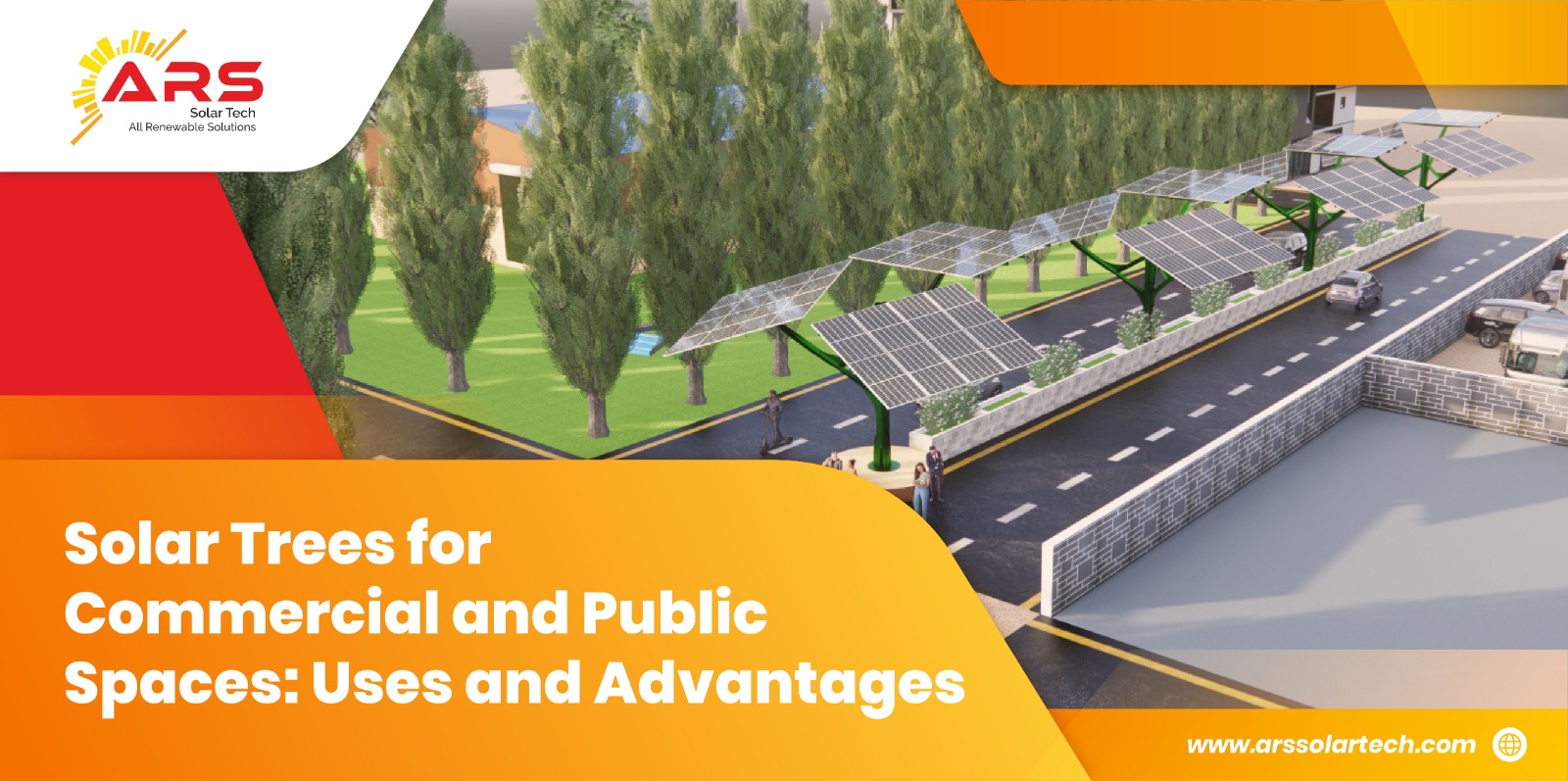
In the rapidly evolving landscape of urban development and renewable energy, a new silhouette is appearing on our horizons—one that combines the elegance of nature with the precision of modern engineering. Solar Trees for Commercial and Public Spaces are no longer just futuristic concepts; they are functional, high-performing architectural assets. At ARS Solartech, we believe that sustainability should not only be efficient but also visually inspiring. As cities become denser and open land becomes a premium, the traditional “flat” approach to solar installation is being challenged. This is where the innovation of solar trees takes center stage, offering a vertical solution to a horizontal problem. What are Solar Trees for Commercial and Public Spaces? A solar tree is a specialized mounting structure that mimics the form of a natural tree. It features a single central “trunk” (pole) with radial “branches” (arms) that support high-efficiency solar panels at optimized angles. Unlike massive ground-mount arrays, Solar Trees for Commercial and Public Spaces like our ARS SunBloom™ series are designed to generate significant power—up to 13 kW per structure—while occupying only a fraction of the ground area. These structures are engineered with advanced materials and corrosion-resistant coatings, ensuring they remain a permanent, low-maintenance fixture in any environment. Top Advantages of Solar Trees for Commercial and Public Spaces Integrating solar technology into public and commercial areas offers benefits that go far beyond simple electricity generation. Here is why forward-thinking developers and municipal planners are choosing this technology: 1. Maximum Land Efficiency The most significant hurdle for solar adoption in urban centers is space. Traditional panels require vast rooftops or empty plots. However, Solar Trees for Commercial and Public Spaces utilize verticality. A single solar tree can support up to 24 panels while leaving the ground level completely free for walkways, seating, or landscaping. 2. Enhanced Energy Yield with Smart Tracking Efficiency is at the heart of the ARS SunBloom™ design. Many of our solar trees incorporate dual-axis tracking systems. By intelligently following the sun from dawn to dusk, these structures can capture up to 40% more energy than static, fixed-tilt systems. This ensures that every square inch of the panel is working at its peak potential throughout the day. 3. Architectural and Aesthetic Value Let’s be honest: traditional solar panels aren’t always built for beauty. Solar Trees for Commercial and Public Spaces change that narrative. They serve as “functional art,” transforming a plain corporate courtyard or a public plaza into a modern, eco-friendly landmark. It sends a powerful, visible message about a brand’s or a city’s commitment to a green future. 4. Multi-functional Utility A solar tree is rarely “just” a power plant. Because they are elevated, they provide much-needed shade in hot climates, creating comfortable gathering spots. They can also be integrated with: EV Charging Stations: Powering the next generation of transport directly from the sun. LED Lighting: Illuminating public paths at night using stored energy. Wi-Fi Hotspots: Providing connectivity in smart city developments. Common Uses of Solar Trees for Commercial and Public Spaces Where do these structures fit best? Their versatility makes them ideal for a wide range of high-traffic areas: Corporate Tech Parks: Companies use solar trees to provide shaded break areas for employees while offsetting the energy costs of large office buildings. University Campuses: They serve as educational tools and charging hubs for students, reinforcing the institution’s sustainability goals. Public Plazas and Smart Cities: Urban planners integrate them into “Smart City” projects to provide public services like lighting and charging without adding to the grid load. Hotels and Resorts: For hospitality brands, solar trees offer a unique aesthetic that appeals to eco-conscious travelers while powering outdoor amenities. Engineering the Future: The ARS Solartech Edge At ARS Solartech, we bring over 12 years of engineering excellence to every project. Our solar trees are not just “off-the-shelf” products; they are precision-engineered structures. We conduct rigorous wind-load and structural stability analyses using advanced simulation tools to ensure that our installations can withstand the elements for decades. Our Solar Trees for Commercial and Public Spaces are designed for “plug-and-play” installation, minimizing disruption to your site. Whether it is our signature ARS SunBloom™ or a custom-designed architectural piece, we focus on durability, performance, and seamless integration. Conclusion Shifting toward sustainable power has evolved from a voluntary option into an absolute requirement for the modern world. Yet, the true impact lies in how we integrate these green technologies into our cities. Solar Trees for Commercial and Public Spaces serve as the ultimate bridge between aesthetic design and practical utility. These structures offer a high-performance energy alternative that addresses the scarcity of urban real estate while simultaneously elevating the visual appeal of our shared landscapes. By choosing a solar tree, you aren’t just installing a power system—you are planting a symbol of innovation that will provide shade, energy, and inspiration for years to come. Ready to transform your space with the power of the sun? Explore our range of architectural solar solutions and see how the ARS SunBloom™ can elevate your next project.