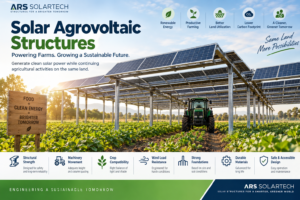
 Solar agrovoltaic structures, also called agrivoltaic solar structures, combine solar power generation with agriculture. These systems allow farmers to grow crops while using the same land to generate clean energy.
Agrivoltaics is gaining attention in India because land availability is a major challenge for large solar projects. Solar panels installed above farmland can create a dual-use system. The land can support both agriculture and solar energy generation.
However, an agrovoltaic structure needs more than a standard solar mounting system. The structure must support solar modules at a suitable height. It must also allow tractors, farm equipment and workers to move safely below the panels.
The design must balance several factors:
Solar Generation + Crop Growth + Structural Strength + Safety + Land Utilization
This article explains the key factors to consider when designing a solar agrovoltaic structure, with a special focus on structural strength, wind loads, foundations, material selection and long-term reliability.
What Is a Solar Agrovoltaic Structure?
A solar agrovoltaic structure supports solar panels above agricultural land. Farmers can continue their agricultural activities below or between the solar panel rows.
The design can vary based on the crop and farming method.
Agrovoltaic structures can support:
- Vegetable farming
- Horticulture
- Orchards
- Fodder crops
- Open-field agriculture
- Grazing
- Protected farming
- Agricultural machinery
- Solar-powered irrigation
The goal is simple.
Use the same land for food production and solar power generation.
Why Agrovoltaic Structures Need Special Design
A standard ground-mounted solar structure mainly focuses on module support and structural stability.
An agrovoltaic structure has more requirements.
The designer must consider:
- Crop height
- Tractor movement
- Farm machinery
- Worker access
- Irrigation systems
- Module height
- Row spacing
- Shading
- Wind loads
- Foundation loads
- Maintenance access
A strong structure alone does not make a good agrovoltaic system.
The structure must also work with the farm.
1. Start With the Agricultural Requirements
The first step is to understand the farming activity.
Design the solar structure around the agricultural operation.
Before finalizing the structure, study:
- Crop type
- Crop height
- Required sunlight
- Farming method
- Tractor size
- Harvester size
- Irrigation system
- Crop row spacing
- Machinery movement
- Harvesting method
- Worker access
For example, a vegetable farm may need a different structure from an orchard.
A tractor may also need a larger clear height than manual farming.
These requirements directly affect the structural layout.
2. Choose the Right Structure Height
Structure height plays an important role in agrovoltaic design.
Higher structures provide more space for:
- Tractors
- Harvesters
- Farm equipment
- Workers
- Crop growth
- Maintenance activities
However, higher structures also face greater wind forces.
As the height increases, the designer may see higher:
- Bending moments
- Column loads
- Foundation loads
- Connection forces
- Structural deflection
Therefore, increasing the height also requires a proper structural review.
Do not simply increase column height without checking the complete structure.
3. Structural Strength Is Critical
Structural strength is one of the most important parts of an agrovoltaic project.
Solar panels create a large surface area. Wind can act on this surface and transfer forces to the structure.
The complete load path must remain safe.
The load travels through:
Solar Module → Rail → Purlin → Beam → Column → Base Connection → Foundation → Soil
Every component must carry its share of the load.
A failure in one component can affect the complete system.
That is why engineers should check the complete structural system instead of looking only at individual steel sections.
4. Wind Load Design
Wind load can become a major design factor for elevated solar structures.
The designer should consider the project location and site conditions.
Important factors include:
- Basic wind speed
- Terrain
- Topography
- Structure height
- Module tilt
- Module arrangement
- Wind direction
- Edge zones
- Corner zones
- Site exposure
Higher solar structures can experience greater wind effects.
The designer must therefore calculate the wind forces and check the resulting member and foundation loads.
A properly engineered structure should resist wind uplift, lateral forces and overturning effects within the applicable design criteria.
5. Structural Analysis and Engineering
A professional agrovoltaic project should include structural analysis.
Engineers can use structural analysis software such as STAAD.Pro or other suitable tools.
The analysis can check:
- Dead load
- Wind load
- Live load
- Maintenance load
- Seismic effects where applicable
- Temperature effects
- Load combinations
- Member capacity
- Deflection
- Connection forces
- Foundation reactions
The design should provide four important qualities.
Strength
The structure must safely carry the design loads.
Stiffness
The structure should control excessive movement and deflection.
Stability
The structure must resist buckling, sliding and overturning.
Durability
The structure should maintain its performance over its intended service life.
6. Foundation Design Matters
A strong steel structure needs a strong and suitable foundation.
This becomes even more important for elevated agrovoltaic structures.
Wind can create significant overturning forces at the foundation.
Engineers should consider:
- Soil type
- Soil bearing capacity
- Foundation depth
- Uplift forces
- Lateral forces
- Overturning moments
- Concrete strength
- Reinforcement
- Anchor bolts
- Groundwater conditions
Depending on the site, the project may use RCC foundations, driven piles, screw piles or other suitable foundation systems.
A soil investigation can help engineers select the right foundation solution.
7. Column Spacing and Farm Machinery
Column placement can directly affect farming operations.
A structurally strong system can still create problems if the columns block tractor movement.
The structural layout should consider:
- Tractor wheel paths
- Machinery width
- Turning radius
- Crop rows
- Farm roads
- Irrigation lines
- Harvesting equipment
- Worker movement
The solar layout and farm layout should work together from the beginning.
This approach can reduce changes during construction.
8. Crop Shading and Solar Panel Spacing
Agrovoltaic design must consider both solar generation and crop growth.
Solar panels create shade below the structure.
The amount of shade depends on:
- Panel height
- Panel orientation
- Tilt angle
- Row spacing
- Panel arrangement
- Sun position
- Crop type
Some crops can tolerate more shade than others.
Therefore, the solar layout should match the crop requirement.
The objective is not simply to install the maximum number of modules.
The objective is to create the right balance between:
Solar Generation + Crop Productivity + Land Utilization
9. Module Tilt and Orientation
Module tilt affects both solar generation and structural loads.
The designer should consider:
- Project location
- Solar generation
- Crop requirements
- Wind conditions
- Row spacing
- Shading
- Maintenance
- Structural forces
A higher tilt angle can increase wind exposure.
A lower tilt angle can change shading and drainage characteristics.
Therefore, engineers should select the tilt angle as part of the complete system design.
10. Material Selection and Corrosion Protection
Agricultural environments can expose structures to moisture, fertilizers, pesticides and irrigation water.
This makes corrosion protection important.
The designer should consider:
- Steel grade
- Section type
- Galvanizing system
- Fasteners
- Connection details
- Drainage
- Fabrication quality
- Site environment
For steel structures, Hot-Dip Galvanizing (HDG) can provide strong corrosion protection when the coating meets the required specification.
Proper detailing also matters.
Water should not remain trapped around connections or structural members.
Good drainage can improve long-term durability.
11. Connection Design Is Equally Important
Strong steel members need strong connections.
Important connections include:
- Column-to-beam connections
- Beam-to-rafter connections
- Purlin connections
- Rail connections
- Base plates
- Anchor bolts
- Bracing connections
Engineers should check:
- Shear
- Tension
- Compression
- Bending
- Bolt capacity
- Bearing
- Slip
- Local stresses
The complete load path should remain continuous.
12. Bracing and Structural Stability
Agrovoltaic structures can become large and tall.
Bracing helps control structural movement.
It can improve resistance against:
- Lateral movement
- Wind sway
- Buckling
- Structural deformation
- Frame instability
The right bracing system depends on the structural configuration and engineering analysis.
Using more steel is not always the answer.
Good engineering creates stability through the right structural system.
13. Maintenance and Safe Access
Solar panels need regular inspection and cleaning.
Agrovoltaic structures should provide safe access for maintenance teams.
The design may include:
- Walkways
- Ladders
- Safety lifelines
- Maintenance platforms
- Access routes
These provisions should form part of the original design.
Adding them later can increase cost and create installation problems.
14. Irrigation and Drainage
Agricultural operations often use drip irrigation, sprinklers and other water systems.
The solar structure should not interfere with these systems.
The design should coordinate:
- Drip lines
- Sprinklers
- Farm drainage
- Rainwater flow
- Water storage
- Foundation drainage
Proper water management also helps protect the structure from corrosion and soil-related problems.
15. Electrical and Structural Coordination
The solar structure and electrical system must work together.
The design should consider:
- DC cable routing
- Cable trays
- Earthing
- Lightning protection
- Junction boxes
- Inverter locations
- Module layout
- Maintenance access
Cable routes should not interfere with tractors or workers.
They should also remain protected from mechanical damage.
Why Structural Strength Matters in Agrovoltaic Projects
An agrovoltaic structure represents a long-term investment.
The structure supports the solar modules throughout the project life.
Structural problems can lead to:
- Module damage
- Power generation losses
- Safety risks
- Agricultural disruption
- Repair costs
- Project downtime
A structural failure can affect both the solar plant and the farming operation.
Therefore, structural engineering should never be treated only as a steel-cost exercise.
The focus should remain on safety, performance and long-term reliability.
Strong Structure Does Not Mean Excessive Steel
A common misconception is that a stronger structure always needs more steel.
Good engineering works differently.
The goal is to achieve the required:
Strength + Stiffness + Stability + Durability
while keeping the structure efficient.
Using unnecessary steel can increase:
- Material cost
- Fabrication cost
- Transportation cost
- Foundation cost
- Installation cost
At the same time, reducing steel without proper analysis can reduce structural safety.
The right approach is engineering optimization.
Design for the Complete Project Life Cycle
An agrovoltaic structure should not be designed only for installation.
The designer should consider the complete project life cycle.
Design
Study agricultural requirements, solar layout, structural loads and foundations.
Manufacturing
Maintain dimensional accuracy and fabrication quality.
Corrosion Protection
Apply the specified coating system and inspect coating quality.
Transportation
Protect components from damage during handling and transport.
Installation
Follow the approved erection method and connection requirements.
Commissioning
Inspect the structural and electrical systems before operation.
Operation
Carry out regular inspections and maintenance.
Long-Term Performance
Monitor corrosion, connections, foundations and structural condition.
Solar Agrovoltaic Structure Design Checklist
Before finalizing the design, check:
- Crop type
- Crop height
- Structure height
- Tractor dimensions
- Machinery movement
- Column spacing
- Module orientation
- Module tilt
- Row spacing
- Shading
- Wind speed
- Terrain
- Site exposure
- Soil conditions
- Foundation design
- Structural member capacity
- Deflection
- Connection design
- Bracing
- Corrosion protection
- Cable routing
- Earthing
- Lightning protection
- Maintenance access
- Safety provisions
- Irrigation
- Drainage
- Installation method
- Long-term maintenance
The Future of Solar and Agriculture
Solar agrovoltaics can create a new model for land use.
Instead of choosing between agriculture and solar power, developers can design systems that support both.
However, successful projects need careful planning.
The structure must work with the:
Crop + Farmer + Machinery + Solar Modules + Soil + Weather + Electrical System
This is where engineering becomes critical.
A professionally designed agrovoltaic structure should deliver:
Strength | Stability | Safety | Durability | Accessibility | Crop Compatibility | Cost Optimization
ARS Solartech: Engineering Solar Structures for Agriculture
At ARS Solartech, we focus on engineering-led solar structure solutions for specialized applications.
Our approach considers more than just module mounting.
We look at the complete project requirement, including:
- Structural design
- Wind load analysis
- Customized elevations
- Agricultural requirements
- Machinery access
- Material selection
- Foundation requirements
- Fabrication
- Corrosion protection
- Installation
- Long-term performance
For agrovoltaic structures, elevated solar structures and customized solar mounting systems, the right design starts with understanding the project from both the solar and agricultural perspectives.
Conclusion
A successful solar agrovoltaic structure must do more than support solar panels.
It must provide a safe and reliable environment for farming activities.
It must handle wind and other design loads.
It must provide enough clearance for machinery.
It must protect the solar modules.
It must support long-term operation.
Most importantly, the structure must balance solar generation with agricultural productivity.
The future of solar is not only about generating more power. It is about designing smarter infrastructure that works with the land.
ARS Solartech – Structures for a Brighter Tomorrow.